
Best Student Loans for College Students in the USA: Complete Guide to Federal & Private Loans (2026)
Table of Contents
Introduction
Higher education remains one of the most valuable investments a student can make. A college degree can increase earning potential, create career opportunities, and provide long-term financial stability. However, rising tuition costs have made paying for college increasingly difficult for many American families.
According to recent education cost trends, students often face expenses that extend beyond tuition, including housing, textbooks, transportation, meal plans, technology requirements, and various university fees. As a result, millions of students rely on financial aid and student loans to fund their education.
Student loans can make higher education accessible, but choosing the wrong loan can create financial challenges for years after graduation. Understanding the differences between federal student loans and private student loans is essential for making informed financial decisions.
This comprehensive guide explains everything college students need to know about student loans in the United States, including loan types, eligibility requirements, repayment options, interest rates, advantages, disadvantages, and strategies for borrowing responsibly.
Understanding Student Loans
A student loan is money borrowed to pay for education-related expenses. Unlike scholarships and grants, student loans must generally be repaid with interest.
Student loans are commonly used to cover:
- Tuition fees
- Housing expenses
- Textbooks
- Laboratory fees
- Technology costs
- Transportation
- Living expenses
The borrower agrees to repay the loan according to specific terms established by the lender.

Why Student Loans Matter
For many students, college would be impossible without financial assistance.
Student loans help students:
Access Higher Education
Many families cannot pay tuition costs upfront.
Loans bridge the financial gap.
Invest in Future Earnings
Higher education often leads to increased earning potential.
Reduce Immediate Financial Burden
Students can focus on their studies rather than paying full educational costs during enrollment.
Expand Career Opportunities
Many professions require advanced education and specialized training.
Types of Student Loans
Student loans generally fall into two categories:
Federal Student Loans
Federal student loans are provided by the federal government.
Advantages include:
- Fixed interest rates
- Flexible repayment plans
- Loan forgiveness programs
- Income-driven repayment options
Federal loans are usually the preferred option for most students.
Private Student Loans
Private student loans are offered by banks, credit unions, and private lenders.
Features vary depending on:
- Credit score
- Income
- Cosigner availability
- Lender requirements
Private loans can help cover educational costs when federal aid is insufficient.
Federal Student Loans Explained
Federal student loans are often considered the best starting point for students because they offer borrower protections that private loans generally do not provide.
Direct Subsidized Loans
These loans are available to eligible undergraduate students who demonstrate financial need.
Key Benefits
- Government pays interest during school
- Lower overall borrowing cost
- Flexible repayment options
Many financial aid experts recommend maximizing subsidized loans before considering other borrowing options.
Direct Unsubsidized Loans
Available to:
- Undergraduate students
- Graduate students
- Professional students
No financial need requirement exists.
Important Difference
Interest begins accruing immediately after disbursement.
Students may choose to:
- Pay interest while enrolled
- Allow interest to accumulate
Direct PLUS Loans
Designed for:
- Graduate students
- Professional students
- Parents of dependent undergraduate students
PLUS loans often have higher borrowing limits.
FAFSA: The First Step
Students seeking federal aid must complete the FAFSA.
FAFSA stands for:
Free Application for Federal Student Aid
Completing FAFSA determines eligibility for:
- Grants
- Scholarships
- Work-study programs
- Federal student loans
Many colleges also use FAFSA information when awarding institutional aid.
Common FAFSA Mistakes
Students should avoid:
Missing Deadlines
Late applications may reduce aid opportunities.
Incorrect Financial Information
Errors can delay processing.
Skipping the FAFSA Entirely
Many students mistakenly assume they will not qualify.
Submitting FAFSA is often worthwhile regardless of family income.
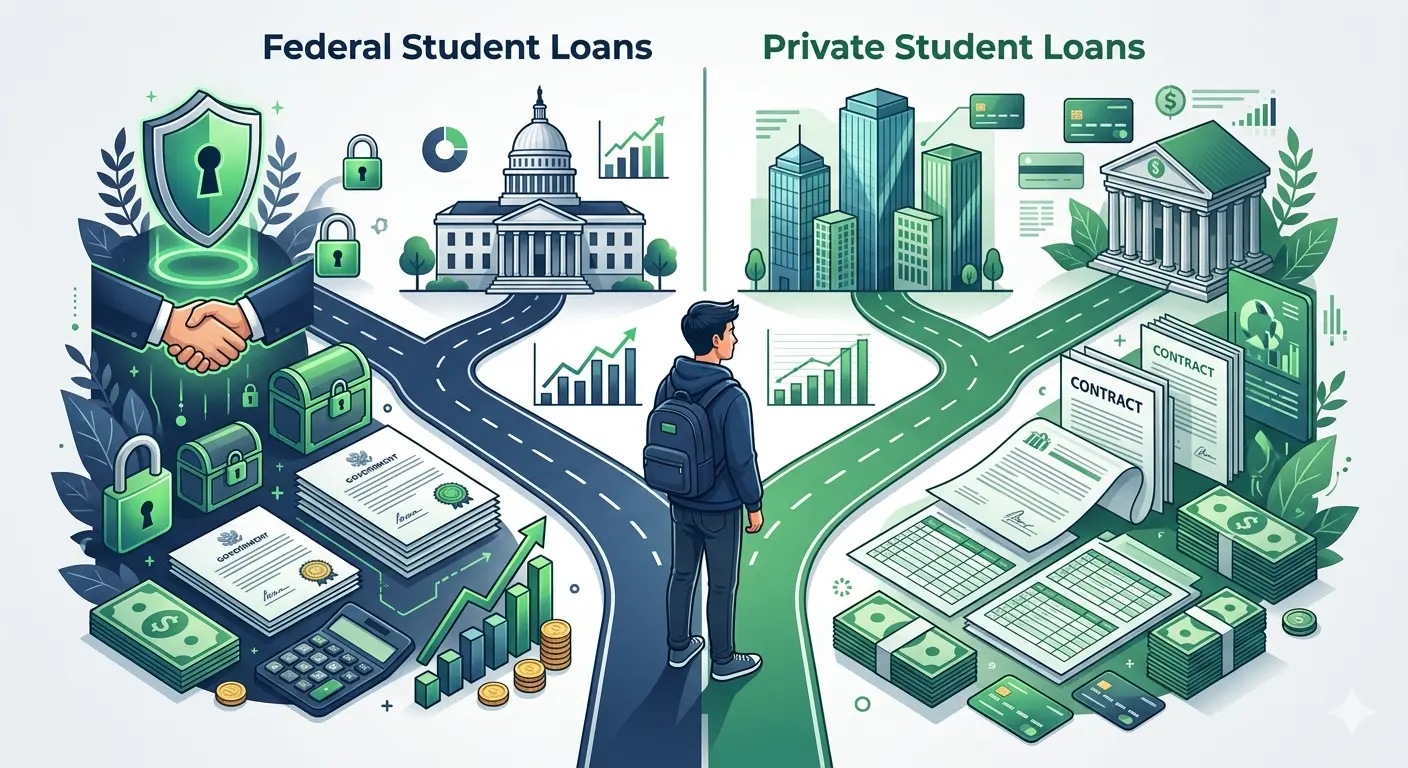
Federal vs Private Student Loans
| Feature | Federal Loans | Private Loans |
|---|---|---|
| Credit Check | Usually No | Often Required |
| Fixed Rates | Yes | Sometimes |
| Income-Based Repayment | Yes | Rare |
| Loan Forgiveness | Available | Rare |
| Government Backing | Yes | No |
| Hardship Protections | Strong | Limited |
Federal loans typically provide more borrower protections.
How Much Should You Borrow?
A common mistake among students is borrowing more than necessary.
Borrow only what is needed to cover:
- Tuition
- Essential living expenses
- Educational materials
Avoid using loan funds for:
- Luxury purchases
- Vacations
- Nonessential spending
Responsible borrowing reduces future financial stress.
Understanding Interest Rates
Interest represents the cost of borrowing money.
Even a small difference in interest rates can significantly affect repayment costs over time.
Students should compare:
- Fixed rates
- Variable rates
- Total repayment costs
- Fees
before accepting any loan offer.
Fixed vs Variable Interest Rates
Fixed Rates
Remain unchanged throughout repayment.
Advantages:
- Predictability
- Stable monthly payments
Variable Rates
May increase or decrease over time.
Advantages:
- Potentially lower starting rates
Risks:
- Future payment increases
Many students prefer fixed-rate loans because they provide certainty.
Student Loan Repayment Plans
Income-Driven Repayment Plans
Link:
https://studentaid.gov/manage-loans/repayment/plans
The Real Cost of Student Debt
Students should understand that borrowed money must eventually be repaid.
A $20,000 loan may cost significantly more after interest is included.
Factors affecting total repayment include:
- Interest rates
- Repayment period
- Payment consistency
- Deferment periods
Planning ahead is essential.
Choosing the Right Student Loan
Before borrowing, ask:
How much do I actually need?
What is the interest rate?
Are repayment options flexible?
Is there a grace period?
Are there borrower protections?
Can I afford repayment after graduation?
Answering these questions helps students make smarter decisions.
Private Student Loans Explained
While federal student loans should generally be the first option for students, private student loans can help fill funding gaps when federal aid is not enough.
Private student loans are offered by:
- Banks
- Credit unions
- Online lenders
- Financial institutions
Unlike federal loans, private lenders evaluate borrowers based on financial risk.
This means approval often depends on:
- Credit score
- Income
- Employment history
- Cosigner strength
When Should Students Consider Private Loans?
Private student loans may be useful when:
Federal Loan Limits Are Reached
Federal borrowing limits may not fully cover educational costs.
Graduate School Expenses
Graduate programs often have higher costs.
International Student Financing
Some private lenders offer specialized programs for international students.
Special Degree Programs
Certain educational programs may require additional funding.
Private loans should generally supplement—not replace—federal student aid.
Advantages of Private Student Loans
Private loans offer several potential benefits.
Higher Borrowing Limits
Many private lenders allow students to borrow up to the total cost of attendance.
This can help cover:
- Tuition
- Housing
- Books
- Transportation
Competitive Interest Rates
Highly qualified borrowers may receive attractive interest rates.
Especially when:
- Strong credit exists
- A qualified cosigner is included
Flexible Loan Terms
Many lenders offer:
- Multiple repayment options
- Various loan lengths
- Different interest structures
Disadvantages of Private Student Loans
Students should understand the risks.
Credit Requirements
Many students have limited credit history.
Approval may require a cosigner.
Fewer Protections
Private loans usually offer fewer protections than federal loans.
Examples:
- Limited hardship options
- Less flexible repayment
- Fewer forgiveness programs
Variable Interest Risks
Some loans use variable rates.
Monthly payments may increase over time.
Understanding Cosigners
A cosigner is someone who agrees to share responsibility for a loan.
Often:
- Parent
- Guardian
- Relative
Benefits include:
- Better approval chances
- Lower interest rates
- Higher borrowing limits
Cosigner Responsibilities
Many families misunderstand cosigner obligations.
If the student fails to make payments:
The cosigner becomes responsible.
This can affect:
- Credit scores
- Debt obligations
- Future borrowing ability
Choose carefully.
Top Features to Compare Before Choosing a Lender
Never select a loan based solely on marketing claims.
Compare the following factors carefully.
Interest Rates
Interest rates directly affect total repayment costs.
Even a 1% difference may result in thousands of dollars over the life of a loan.
Fees
Some lenders charge:
- Origination fees
- Late fees
- Returned payment fees
Lower fees reduce overall borrowing costs.
Repayment Flexibility
Look for lenders offering:
- Deferment options
- Forbearance programs
- Flexible payment plans
Unexpected financial difficulties can occur after graduation.
Customer Service
Good support becomes important when issues arise.
Research:
- Reviews
- Ratings
- Customer experiences
before selecting a lender.
Student Loan Repayment Basics
Many students focus only on obtaining loans.
Understanding repayment is equally important.
Most loans eventually require monthly payments.
What Is a Grace Period?
A grace period is the time between leaving school and beginning repayment.
Many federal loans offer:
Six months before required payments begin.
This gives graduates time to:
- Find employment
- Establish income
- Adjust financially
Standard Repayment Plan
The standard plan generally involves fixed monthly payments.
Benefits include:
- Faster payoff
- Less interest paid overall
This plan works well for borrowers with stable income.
Income-Driven Repayment Plans
Federal loans may qualify for income-driven repayment.
Payments are based on:
- Income
- Family size
- Financial circumstances
These plans can improve affordability.
Benefits of Income-Based Repayment
Advantages include:
Lower Monthly Payments
Payments remain manageable.
Financial Flexibility
Helpful during career transitions.
Potential Loan Forgiveness
Remaining balances may qualify for forgiveness after a specified period.
Student Loan Forgiveness Programs
One of the biggest advantages of federal loans is potential forgiveness opportunities.
Public Service Loan Forgiveness (PSLF)
Designed for borrowers working in public service careers.
Examples include:
- Teachers
- Government employees
- Nonprofit workers
Eligible borrowers may receive forgiveness after meeting specific requirements.
Teacher Loan Forgiveness
Some educators may qualify for forgiveness programs.
Requirements vary.
Eligibility often depends on:
- Teaching location
- Subject area
- Years of service
Student Loan Calculator
Loan Consolidation Explained
Loan consolidation combines multiple federal loans into one loan.
Benefits include:
- Single monthly payment
- Simplified management
However, consolidation may affect certain benefits.
Always review details carefully.
Student Loan Refinancing
Refinancing differs from consolidation.
Refinancing replaces existing loans with a new loan.
The goal is usually:
- Lower interest rates
- Reduced monthly payments
Benefits of Refinancing
Qualified borrowers may receive:
Lower Rates
Reduced borrowing costs.
Simplified Repayment
One loan instead of several.
Improved Cash Flow
Potentially lower monthly obligations.
Risks of Refinancing Federal Loans
Many borrowers overlook an important issue.
Refinancing federal loans with a private lender often means losing:
- Federal protections
- Income-driven repayment
- Forgiveness eligibility
Careful evaluation is essential.
Common Student Loan Mistakes
Students frequently make avoidable errors.
Borrowing Too Much
Only borrow what is necessary.
Future repayment can become challenging.
Ignoring Interest Accumulation
Interest continues growing on many loans.
Small balances can become much larger over time.
Missing Payments
Late payments may damage credit scores.
Consistent payments are important.
Failing to Understand Loan Terms
Always read:
- Interest details
- Repayment schedules
- Fees
- Conditions
before signing.
Budgeting During College
Smart budgeting reduces borrowing needs.
Ways to Reduce Educational Costs
Apply for Scholarships
Scholarships reduce reliance on loans.
Seek Grants
Many grants never require repayment.
Work Part-Time
Additional income can offset expenses.
Buy Used Textbooks
This often saves hundreds of dollars annually.
Limit Nonessential Spending
Small savings accumulate over time.
Scholarships vs Student Loans
Many students confuse financial aid categories.
Scholarships
Characteristics:
- No repayment required
- Merit-based or need-based
- Competitive application process
Grants
Characteristics:
- Usually need-based
- No repayment required
Student Loans
Characteristics:
- Must be repaid
- Interest may apply
Students should maximize scholarships and grants before borrowing.
Student Loans for Graduate Students
Graduate education often requires additional financing.
Common programs include:
- MBA programs
- Medical school
- Law school
- Master’s degrees
Graduate students typically borrow larger amounts.
This makes careful planning even more important.
Student Loans for International Students
International students face unique financing challenges.
Many federal programs are unavailable.
Some private lenders offer specialized international student loans.
Requirements often include:
- Eligible school enrollment
- Cosigner support
- Visa documentation
Research thoroughly before applying.
How Student Loans Affect Credit Scores
Student loans can influence credit history positively or negatively.
Positive Impact
When managed responsibly:
- Builds credit history
- Demonstrates reliability
- Improves future borrowing opportunities
Negative Impact
Missed payments may lead to:
- Credit damage
- Collection activity
- Higher borrowing costs
Responsible management is essential.
The Future of Student Loan Borrowing
Education financing continues evolving.
Emerging trends include:
- Digital loan platforms
- AI-based lending analysis
- Improved borrower education
- Flexible repayment solutions
Students should stay informed about changing policies and opportunities.
Building a Student Loan Strategy
A smart borrowing strategy includes:
Step 1
Complete FAFSA.
Step 2
Accept grants and scholarships first.
Step 3
Use federal loans before private loans.
Step 4
Borrow only necessary amounts.
Step 5
Understand repayment obligations.
Step 6
Create a post-graduation repayment plan.
This approach minimizes financial risk.
1-Year Diploma Courses in the USA for International Students (2025 Guide)
Example Student Loan Scenario
Consider a student attending a public university.
Annual costs:
- Tuition: $12,000
- Housing: $8,000
- Books: $1,500
- Miscellaneous: $2,500
Total Cost:
$24,000 annually
Financial Aid:
- Scholarships: $6,000
- Grants: $4,000
Remaining Need:
$14,000
The student may use:
- Federal loans first
- Private loans only if necessary
This reduces long-term borrowing costs.
Key Takeaways
✓ Complete FAFSA every year
✓ Prioritize grants and scholarships
✓ Maximize federal loan benefits
✓ Compare private lenders carefully
✓ Understand repayment terms
✓ Borrow only what is necessary
✓ Consider future earning potential
✓ Avoid unnecessary debt
Best Private Student Loan Lenders in the USA
When federal student aid is insufficient, many students consider private student loan lenders. The right lender depends on your financial profile, credit score, educational goals, and repayment preferences.
Rather than choosing based on advertisements, students should compare:
- Interest rates
- Repayment flexibility
- Cosigner options
- Customer support
- Hardship programs
- Loan limits
What Makes a Good Student Loan Lender?
A quality lender typically offers:
Competitive Interest Rates
Lower rates reduce total borrowing costs.
Flexible Repayment Terms
Students benefit from repayment options that match their financial situation.
Cosigner Release Programs
Some lenders allow cosigners to be removed after a period of successful payments.
Strong Customer Service
Good support becomes valuable when financial challenges occur.
Financial Education Resources
The best lenders help students make informed decisions.
How to Compare Student Loan Offers
Many students focus only on monthly payments.
This can be a mistake.
Instead, evaluate:
Annual Percentage Rate (APR)
APR reflects the true borrowing cost.
Total Repayment Cost
Calculate the amount repaid over the life of the loan.
Loan Length
Longer repayment terms reduce monthly payments but increase interest costs.
Repayment Benefits
Some lenders offer:
- Autopay discounts
- Loyalty benefits
- Graduation rewards
Student Loan Interest Rates Explained
Interest rates significantly impact long-term debt.
Even small differences matter.
Consider two students borrowing the same amount.
Student A receives a lower rate.
Student B receives a higher rate.
Over 10–15 years, Student B may pay thousands more in interest.
This highlights the importance of comparison shopping.
Fixed vs Variable Student Loans
Students frequently ask which option is better.
The answer depends on risk tolerance.
Fixed Rate Loans
Advantages:
- Predictable payments
- Stable budgeting
- Protection from future rate increases
Best for students seeking financial certainty.
Variable Rate Loans
Advantages:
- Lower initial rates
Potential disadvantages:
- Rates may increase
- Future payments may rise
Variable rates carry greater uncertainty.
Student Loan Debt Statistics
Student debt remains one of the largest forms of consumer debt in the United States.
Millions of borrowers carry student loan balances.
Common reasons include:
- Rising tuition
- Housing costs
- Graduate education expenses
- Limited financial aid
Understanding debt before borrowing is essential.
The True Return on Investment (ROI) of College
Student loans should be viewed as an investment.
However, not all educational paths generate equal financial returns.
Students should evaluate:
Career Opportunities
What jobs are available after graduation?
Expected Salary
How much can graduates realistically earn?
Industry Demand
Is the field growing?
Debt-to-Income Ratio
Can future income support loan repayment?
These questions help determine educational ROI.
High ROI Degree Programs
Historically, several fields have produced strong earning potential.
Examples include:
Engineering
Strong demand and competitive salaries.
Computer Science
Technology careers continue expanding.
Healthcare
Many healthcare professions remain in high demand.
Finance
Financial careers often offer significant growth opportunities.
Data Analytics
Data-driven industries continue growing globally.
Degrees That Require Careful Financial Planning
Every degree has value, but students should evaluate costs carefully.
Questions to consider:
- What are average starting salaries?
- What is the employment rate?
- How much debt will be required?
Responsible planning reduces financial stress after graduation.
Student Loan Repayment Strategies
A repayment strategy can save thousands of dollars.
Strategy 1: Pay Interest During School
For unsubsidized loans:
Interest accumulates while enrolled.
Paying interest early prevents balance growth.
Strategy 2: Make Extra Payments
Additional payments reduce:
- Principal balance
- Total interest paid
- Repayment duration
Even small extra payments can make a difference.
Strategy 3: Use Autopay
Many lenders provide rate discounts.
Benefits include:
- Reduced interest
- Fewer missed payments
Strategy 4: Refinance Strategically
Qualified borrowers may secure lower rates after graduation.
Refinancing can reduce costs significantly.
Student Loan Refinancing Guide
Refinancing involves replacing existing loans with a new loan.
Potential goals include:
- Lower rates
- Lower payments
- Simplified repayment
However, refinancing should be approached carefully.
When Refinancing Makes Sense
Refinancing may be beneficial when:
Credit Scores Improve
Better credit often leads to lower rates.
Income Increases
Stable income improves lender confidence.
Rates Are Lower Than Existing Loans
Lower rates can generate substantial savings.
When Refinancing May Not Be Ideal
Avoid refinancing federal loans if you rely on:
- Income-driven repayment
- Federal protections
- Loan forgiveness programs
These benefits may be lost.
Student Loan Debt Reduction Techniques
Reducing debt quickly improves financial flexibility.
Snowball Method
Focus on paying off the smallest balances first.
Benefits:
- Faster psychological wins
- Increased motivation
Avalanche Method
Focus on highest-interest loans first.
Benefits:
- Greater interest savings
- Faster debt optimization
Many financial experts prefer this method.
Building Credit While Repaying Student Loans
Student loans can help establish credit history.
Positive habits include:
Paying On Time
Payment history is a major credit factor.
Avoiding Delinquencies
Late payments can harm credit scores.
Monitoring Credit Reports
Review reports regularly for accuracy.
Good credit helps with:
- Mortgages
- Car loans
- Credit cards
- Future financial opportunities
Student Loans and Parents
Parents often play a significant role in education financing.
Before borrowing, families should discuss:
- Total costs
- Repayment expectations
- Financial responsibilities
- Future goals
Transparency reduces misunderstandings.
Parent PLUS Loans
Parent PLUS Loans allow eligible parents to borrow for educational expenses.
Benefits include:
- Higher borrowing limits
- Federal protections
Consider affordability carefully before borrowing.
Financial Planning for College Students
Borrowing is only one part of college financing.
Students should also focus on:
Emergency Savings
Even small savings can help during unexpected situations.
Budget Management
Track:
- Housing costs
- Food expenses
- Transportation
- Entertainment
Good budgeting reduces debt.
Scholarship Applications
Many scholarships go unclaimed every year.
Students should apply consistently.
Part-Time Employment
Strategic employment can reduce borrowing needs.
Balance work and academic responsibilities carefully.
USA vs UK Student Loan Systems
Many international readers compare American and British education financing.
USA Student Loan System
Characteristics include:
- Federal aid programs
- Private lenders
- Multiple repayment plans
- Variable tuition costs
UK Student Loan System
Characteristics include:
- Government-managed funding
- Income-based repayment systems
- Different repayment thresholds
The systems operate differently but share the goal of increasing educational access.
Common Student Loan Myths
Misunderstanding loans can create financial problems.
Myth 1: Student Loans Are Free Money
Reality:
Loans must generally be repaid with interest.
Myth 2: Monthly Payments Don’t Matter Until Graduation
Reality:
Planning should begin before borrowing.
Myth 3: More Borrowing Is Better
Reality:
Only borrow what is necessary.
Myth 4: Refinancing Is Always Good
Reality:
Benefits and risks must be evaluated carefully.
Future Trends in Student Financing
Education financing continues evolving.
Emerging developments include:
AI-Based Financial Planning
Personalized borrowing recommendations.
Enhanced Financial Literacy
More educational tools for students.
Flexible Repayment Structures
Programs tailored to borrower income.
Digital Loan Management
Improved online servicing platforms.
Complete Student Loan Checklist
Before accepting any student loan:
✓ Complete FAFSA
✓ Maximize scholarships
✓ Maximize grants
✓ Compare federal and private options
✓ Understand interest rates
✓ Review repayment terms
✓ Calculate future payments
✓ Borrow only what is necessary
✓ Consider expected career income
✓ Create a repayment plan
Expert Tips for College Students
Tip 1
Start financial planning before enrollment.
Tip 2
Research earning potential for your chosen field.
Tip 3
Apply for scholarships every year.
Tip 4
Understand every loan document before signing.
Tip 5
Track all borrowing carefully.
Tip 6
Avoid lifestyle inflation during college.
Tip 7
Build credit responsibly.
Tip 8
Think long-term rather than semester-by-semester.
Final Thoughts
Student loans can provide access to educational opportunities that might otherwise be unavailable. When used responsibly, they allow students to invest in knowledge, skills, and future earning potential.
The key is informed decision-making.
Students who understand federal aid, compare private loan options carefully, borrow conservatively, and create strong repayment plans are more likely to achieve long-term financial success.
Education can be one of the most valuable investments a person makes—but every investment should be approached with careful planning and realistic expectations.
Conclusion
Student loans play an important role in helping millions of students access higher education. Understanding the differences between federal and private loans, completing FAFSA correctly, comparing interest rates, and borrowing responsibly can significantly improve long-term financial outcomes.
Federal student loans generally provide the strongest protections and should usually be considered before private loan options. However, every student’s situation is unique, making careful research and financial planning essential.